

.svg)

.svg)
%203.svg)


AI in Manufacturing: The Silent Revolution Reshaping Factories

Factories leak value long before a product leaves the line. Globally, unplanned downtime alone consumes 8–11% of revenue, amounting to roughly $1.4 trillion annually. Applied to India’s ~$490 billion manufacturing value added in 2024, that implies $40–50 billion lost each year just to breakdowns and stoppages. Add chronic underutilization with capacity stuck around 60–70% versus the 79–80% typically needed to trigger fresh investment and India is plausibly leaving $100B+ in annual value unrealized. This is the productivity gap AI-native factories can meaningfully close.
The contrast with China sharpens the urgency. China produces roughly $4.66 trillion in manufacturing output (≈28% of global share) versus India’s ~$490 billion (<3%). Much of this delta is productivity: Chinese factories generate an estimated ~$42,000 of manufacturing value per worker annually, compared to ~$8,000 in India - a near five-fold difference driven by higher automation, tighter process control, and fewer bottlenecks. Capacity utilization in China operates in the mid-70% range, with logistics costs around 8% of GDP, while India has historically operated at 60–70% utilization and logistics costs near 14% of GDP.
Closing this “productivity delta” not wage arbitrage is India’s real manufacturing opportunity. AI-driven scheduling, predictive maintenance, and automated quality control offer a path to leapfrog.
Why AI adoption is now a Manufacturing Imperative
The next manufacturing step-change will not come from digitization alone - it will come from digitization + AI-led automation.
Three structural shifts make AI imperative:
1. From Visibility to Autonomy
Factories today generate terabytes of sensor, PLC, CNC, and vision data. AI models from time-series transformers to reinforcement learning engines - can convert this into predictive and prescriptive actions:
- Predictive maintenance reducing downtime by 30–50%
- Quality inspection accuracy exceeding 99% using vision AI
- Reinforcement-learning schedulers optimizing throughput in real time
In electronics manufacturing, companies like Foxconn have deployed AI-driven defect detection systems replacing manual inspectors. In automotive plants, BMW uses AI vision systems for real-time paint inspection, eliminating thousands of manual checks.
2. Economics Have Shifted
Cloud compute costs have fallen >80% over the past decade (AWS pricing benchmarks). Edge AI chips from companies like NVIDIA now allow on-device inference in harsh factory environments.
This means inference can happen on the shopfloor, in real time - even in bandwidth-constrained Indian plants.
3. LLMs Unlock Human-AI Collaboration
Large Language Models are now being integrated into industrial workflows:
- Conversational copilots for maintenance teams
- Automated root cause analysis from machine logs
- SOP generation from historical production data
- Cross-shift knowledge capture (“tribal knowledge digitization”)
Instead of replacing workers, LLM systems augment supervisors and operators compressing decision cycles from hours to minutes.
In India’s context - fragmented MSME supply chains, brownfield plants, and tight margins—the only realistic way to simultaneously raise uptime, quality, and compliance is to digitize and automate together. AI becomes the intelligence layer on top of connected machines, historians, and MES/ERP systems. Factories that lag on this stack will struggle to compete in “China‑plus‑one” supply chains that now implicitly benchmark against China’s robot‑dense, increasingly lights‑out plants.
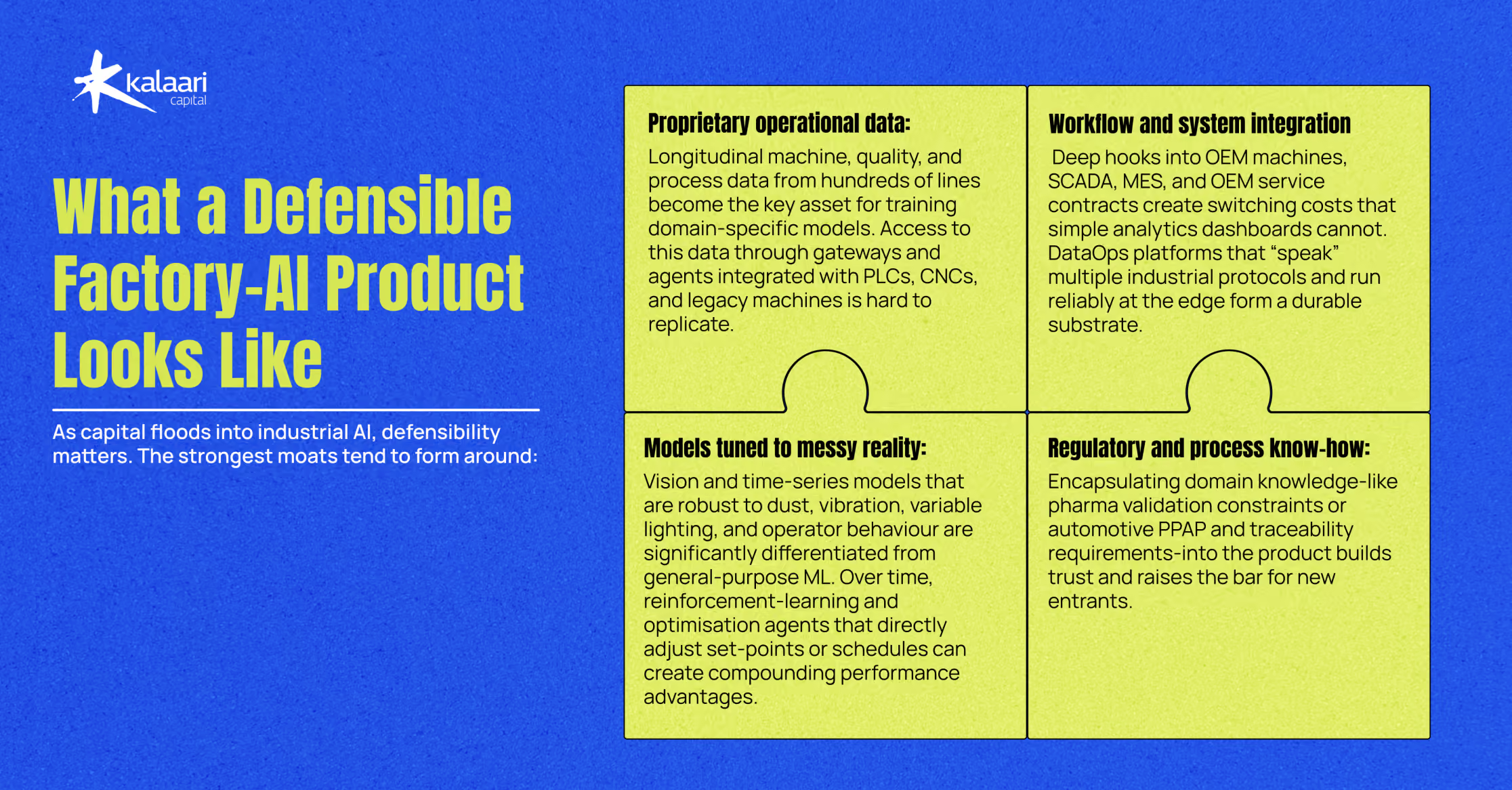
Market Signals: A Global Opportunity with India at an Inflection
Global investment in industrial AI and Industry 4.0 exceeded $20B over the last five years and the global smart manufacturing market is projected to exceed $400B by 2030.
On the other hand, India targets $1T+ manufacturing output by 2030 (Make in India vision). Yet only ~15–20% of Indian factories are meaningfully digitized - creating a rare opportunity.
Funding in India is clustering around four vectors:
- AI-native quality & inspection (computer vision + LLM workflows)
- Predictive maintenance & anomaly detection
- Production Optimization
- Industrial DataOps platforms that unify machine-level data for AI readiness
The Emerging Startup Landscape in Factory AI
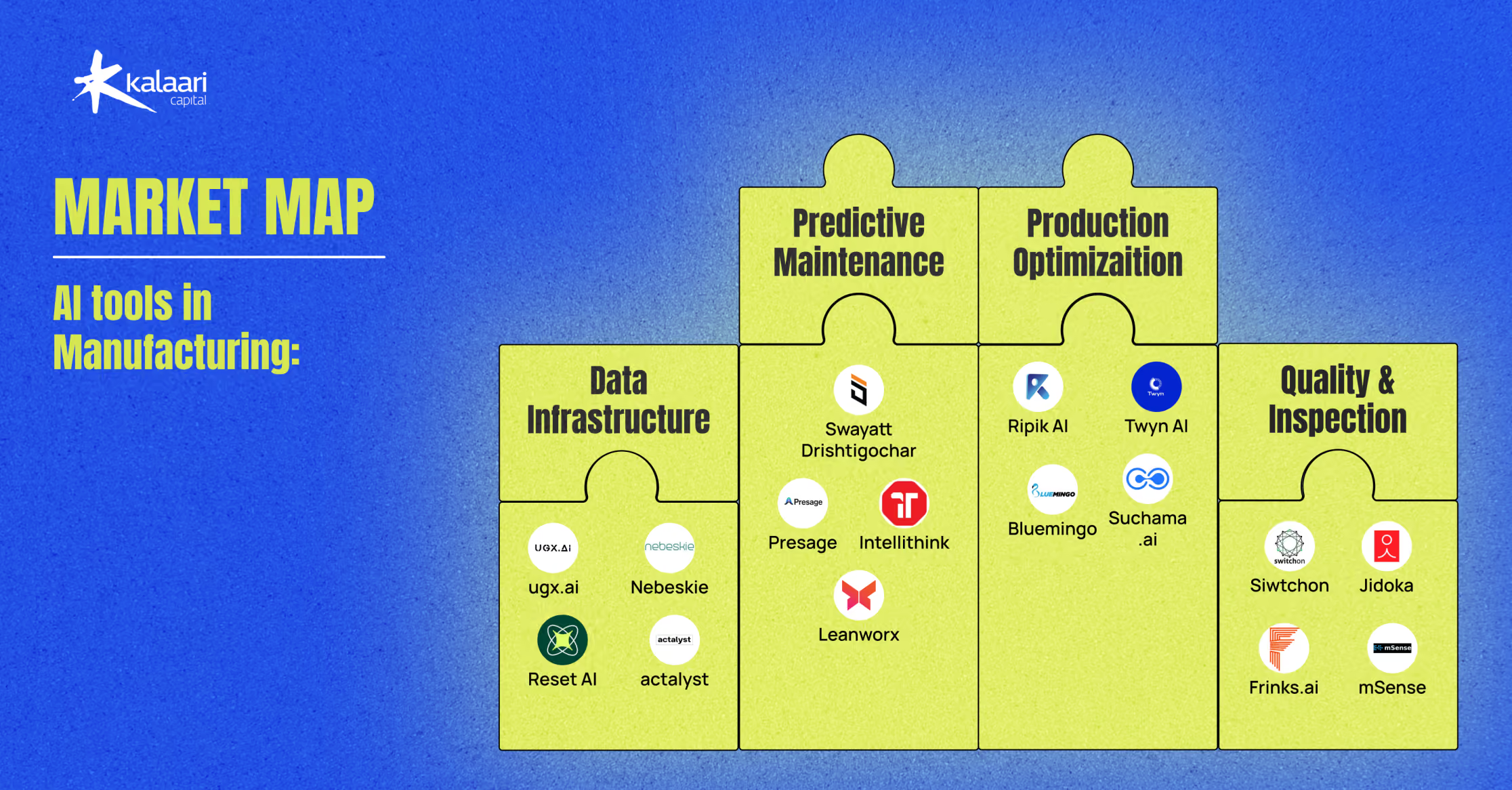
Across the manufacturing value chain, Indian start-ups are building in distinct layers - from unlocking machine data to deploying AI applications to driving autonomous factory decisions.
Data Infrastructure Players
These companies form the foundational layer of Factory AI. They build universal gateways, protocol libraries, edge compute, and machine data pipelines that make real-time visibility possible. Without this layer, AI systems cannot scale across fragmented machine environments.
AI Applications – Specialized intelligence for the shopfloor
a. Predictive Maintenance
Startups here use vibration, acoustic, or machine-signature data to anticipate failures before they occur. They help manufacturers reduce unplanned downtime, extend asset life, and improve reliability in high-value equipment.
b. Production Optimization & Factory Efficiency
These companies build AI systems that improve throughput, balance line efficiencies, optimize schedules, or enhance utilization. Some are evolving into autonomous factory agents, where reinforcement-learning engines dynamically adjust operations.
c. Quality & Inspection
Vision-AI companies that automate defect detection, classification, and real-time quality monitoring. They are especially relevant for auto components, electronics, FMCG, precision manufacturing, and packaging.
India’s AI‑First Industrial Moment
AI in manufacturing is moving from “nice to have” to core infrastructure. India’s unique context - fragmented factories, legacy machines, affordability constraints - makes it a proving ground for industrial AI that is modular, mobile-first, offline-tolerant, and globally exportable.
We believe the next decade will see India produce category-defining industrial software companies, built on strong DataOps foundations and AI-native workflows. Startups solving for India’s hardest factory conditions will be the ones that scale globally.
AI will not replace factory workers - it will augment them, digitize tribal knowledge, and help India transition from a cost-efficient manufacturing hub to a quality-dominant, intelligence-driven global leader.
If you’re building vertical AI, we’d love to connect. Reach out to us at Investments@kalaari.com


.svg)

.svg)

More
BLOGS
.png)