

.svg)

.svg)
%203.svg)


Energy Storage: Can India Keep Its Clean Power for When It Is Needed?
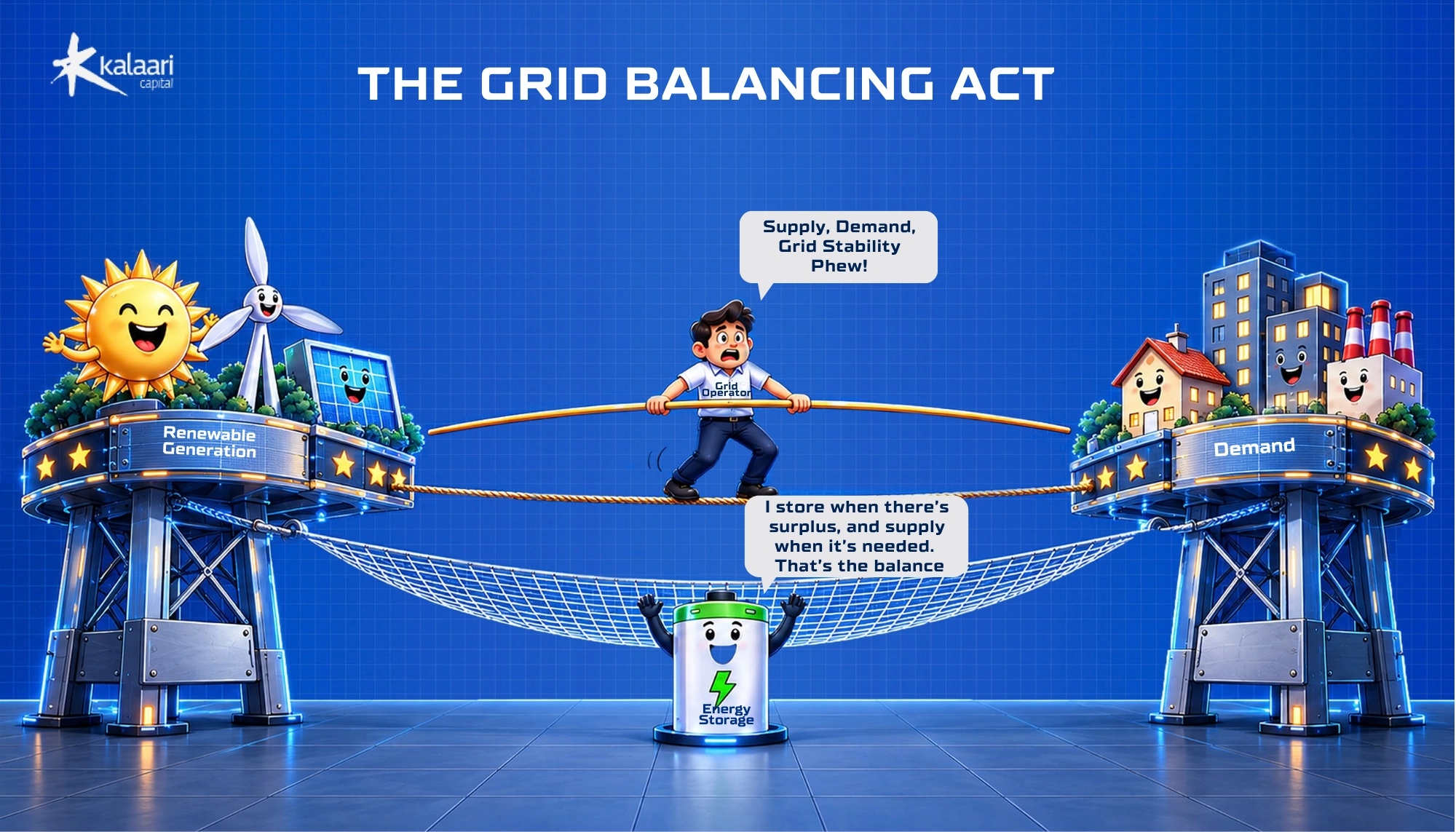
On 6 July 2026, solar, wind, hydro and nuclear plants together met 50.02% of India's electricity demand of 221.5 GW. It was the second year in a row that clean sources had crossed half of national demand at a point in the day, following a similar moment in July 2025, and it reflected how far India’s energy ecosystem has moved. India now has more than 300 GW of non-fossil generation capacity, over half of everything installed.
That moment came close to noon, when solar output is strongest. As the afternoon wore on and solar generation fell away, demand did not fall with it. Lights, fans and air conditioners came on through the evening, and the shortfall was met largely by coal plants ramping up. Over the course of the day the country produced a large amount of clean electricity, but it had very little ability to hold any of it for the hours when it was needed most.
Demand is also growing and becoming harder to serve: peak demand reached a record 270.8 GW in May 2026, and while industrial electrification, electric vehicles and data centres keep adding loads with daily patterns of their own. Energy supply has to meet this demand in the hours when it is most needed.
On the supply side, energy output can swing within minutes as clouds pass or winds shift, which makes renewables a far more erratic source of generation that the grid has to balance in real time.
This gap between when clean electricity is produced and when it is needed, and how steadily it arrives, is one of the largest unresolved problems in India's renewable energy story.


.svg)

.svg)

More
NEWSLETTERS
.png)
.png)