THE OPPORTUNITY
Building the execution layer for enterprise Cloud Operations
Over the last decade, enterprise software has moved decisively to cloud-native, multi-cloud, containers, and microservices. The way enterprises build software has fundamentally changed. The way they operate it has not.
Today, SRE, Cloud Ops, and FinOps teams hold modern infrastructure together through a fragmented stack of point products, custom scripts, dashboards, batch jobs, and siloed expertise — observability tools, CI/CD pipelines, ticketing systems, and cloud consoles, glued together with tribal knowledge. Each tool holds part of the picture; none holds the whole.
The operational cost of this fragmentation compounds in three ways. First, the sheer number of tools creates a crushing onboarding and context-switching tax — new engineers take months to learn each team’s tool combinations and unwritten runbooks before they can safely act on anything. Second, even though access and responsibilities are siloed tool-by-tool, the reality on the ground is that lean engineers wear multiple hats — the same person triages a P1, chases a cost spike, reviews a Kubernetes upgrade, and sits on a compliance audit, often within the same week. Third, and most underappreciated, every enterprise runs the same tech stack differently — two companies on identical observability, ticketing, and cloud stacks still handle incidents, approvals, and change control in entirely different ways. Generic automation doesn’t land in production; enterprise-specific automation is what actually runs.
As multicloud and hybrid cloud adoption accelerates, this operational sprawl is multiplying. The cost is becoming hard to ignore:
• Over 90% of mid-size and large enterprises now report single-hour downtime costs exceeding $300,000, with 41% reporting $1M–5M+ per hour (ITIC 2024 Hourly Cost of Downtime Survey)
• ~29% of public cloud spend runs wasted on average, and 84% of organisations cite cloud cost management as their top challenge — rising in priority with the AI workload boom (Flexera 2026 State of the Cloud Report)
• Cloud-native talent remains scarce: 82% of organisations cite the AI/ML and cloud-native talent shortage as a top barrier to modernising operations (CNCF 2024 Annual Report)

A decade of AIOps and observability has taught enterprises a great deal about what is happening in their infrastructure. It has done far less to help them act on it. Diagnosis and remediation remain largely manual, engineers piecing together evidence across fragmented tools, validating hypotheses, and coordinating fixes by hand.
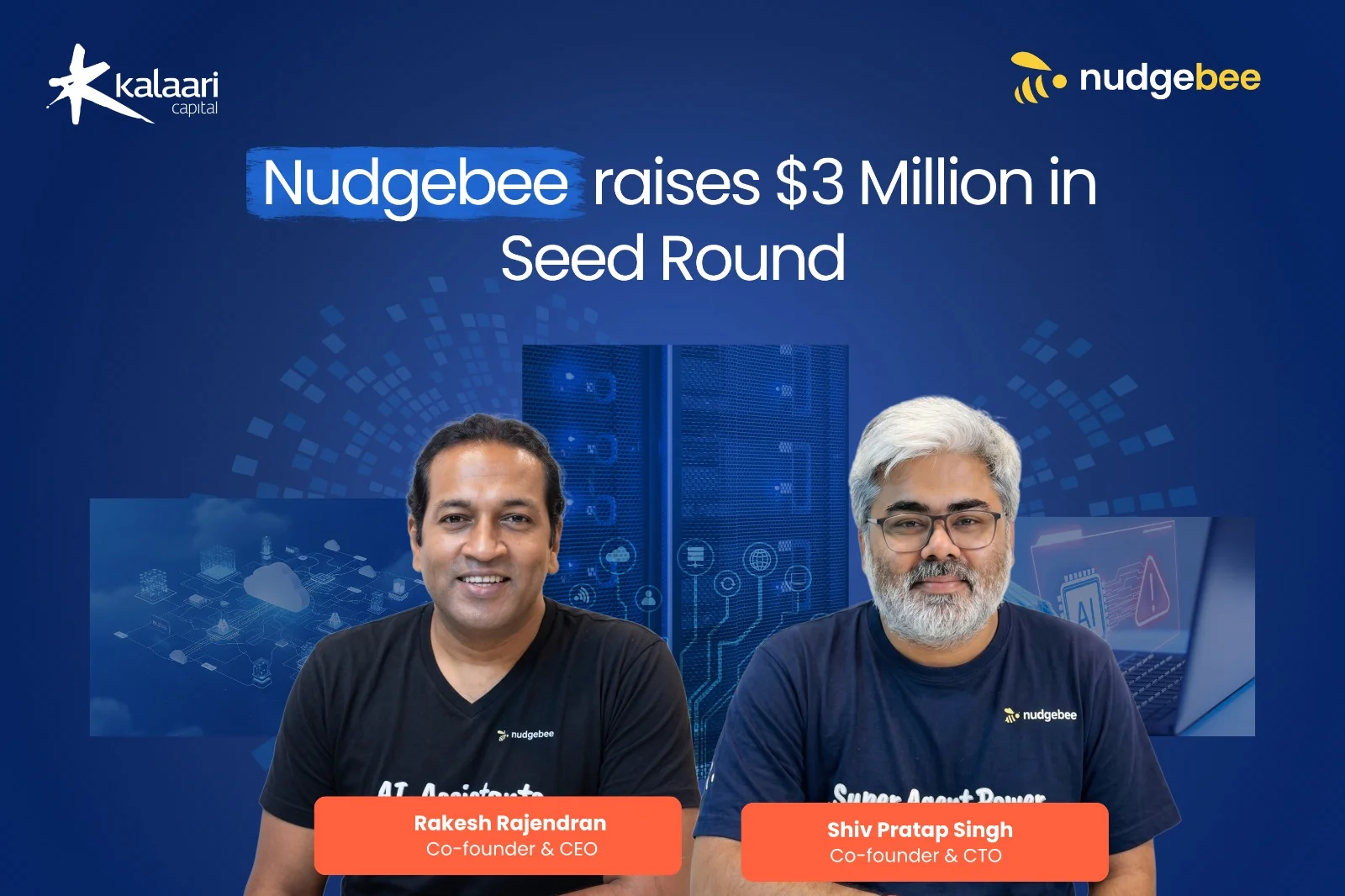
This is the gap NudgeBee is built to close. We are proud to lead NudgeBee’s $3M seed round as they build a multi-functional AI-agentic platform that moves enterprises from passive monitoring to proactive execution across SRE, FinOps, and Cloud Ops.

THE FOUNDING TEAM
Founders who lived the problem before they built the product
NudgeBee is founded by Rakesh Rajendran (Co-founder & CEO) and Shiv Pratap Singh (Co-founder & CTO). They were building and operating data platforms for Global 2000 companies when they saw, at close range, how fragmented Day-2 operations were quietly becoming one of the most expensive problems in enterprise technology. NudgeBee was founded in 2024 and came out of stealth in early 2025.
Rakesh Rajendran, Co-founder & CEO
Rakesh is a serial entrepreneur and operator with deep experience building and scaling enterprise data platforms for large global organisations. Before NudgeBee, he led Delivery and Operations at Saama, the Bay Area–based data and analytics platform company, where he worked closely with complex enterprise environments and saw firsthand how fragmented Day-2 operations slowed teams down. He previously held leadership roles at Reliance Retail and Walgreens, and is a graduate of NIT Calicut. He also brings strong technical depth to the company, including patented work in distributed systems — reinforcing NudgeBee’s foundation in solving hard infrastructure problems with rigour and scale.
Shiv Pratap Singh, Co-founder & CTO
Shiv combines product engineering discipline with hands-on experience building data platforms for demanding enterprise use cases. Before co-founding NudgeBee, he ran Pollux, a product engineering firm supporting Bay Area startups, and later led data platform engineering at Saama, where he helped design and deliver large-scale data systems across regulated industries. Shiv has spent his career at the intersection of Kubernetes, distributed systems, and enterprise-grade platform design — precisely the surface area NudgeBee now automates.
Together, the founders bring a rare mix of enterprise operations insight, platform engineering depth, and first-hand experience with the fragmentation that modern SRE, Cloud Ops, and support teams face every day. NudgeBee is the product they wished existed for themselves.
THE UNIQUE APPROACH

One unified platform across the three disciplines of Cloud Operations
SRE, FinOps, and Cloud Ops have long been treated as three separate categories — three budgets, three tool stacks, three vendor lists. In practice, they share the same underlying data, the same infrastructure context, and increasingly, the same operator. NudgeBee is the first platform designed around that reality.
At the core sits a proprietary Semantic Knowledge Graph and Enterprise Context Layer that unifies telemetry, topology, incident history, and workflow state into a single shared foundation. On top of it, the platform delivers three capabilities that would otherwise require three separate tools:
• Pre-built AI agents for incident troubleshooting and SRE automation — triaging alerts, correlating signals, and compressing MTTR from hours to minutes.
• An AI-FinOps Assistant that identifies and executes cloud cost optimisations, reducing wasted spend by 40–60%.
• An AIOps Automation Builder that lets teams encode repetitive operational work into custom agentic workflows, driving automation up to 5× faster.
Because all three functions draw from the same context layer, NudgeBee can connect a cost anomaly to an infrastructure event, link a recurring incident to an unexecuted optimisation, and act — not just alert.
Equally important is what this architecture unlocks on top of it. In our diligence, a consistent theme we heard from enterprise operators is that tech stacks converge, but processes don’t. Two enterprises running identical observability, ticketing, and cloud stacks still differ sharply in how they triage a P1, approve a rightsizing PR, or handle a compliance drift event. Generic automation fails at this boundary; enterprise-specific automation is what actually gets deployed. NudgeBee’s AIOps Automation Builder is designed precisely for this layer, letting customers compose their own runbooks and agentic workflows on top of the shared context layer, using 30+ pre-wired integrations and an extensive specialist-agent library as building blocks. The platform brings unification without enforcing uniformity.
Three product decisions stood out to us. The platform is self-hosted by default (VPC or on-prem, SOC 2 Type II and ISO 27001 certified, with zero data egress). It is model-agnostic with Bring-Your-Own-Model support across OpenAI, Anthropic, Bedrock, and self-hosted SLMs. And human-in-the-loop controls are a first-class design primitive, with RBAC, audit trails, and approval gates on every production action. The agent recommends; the engineer decides.
Early Traction:
Validated in production with enterprise-scale operators
The thesis is already being validated in production. Rackspace, one of the world’s largest managed cloud providers serving thousands of enterprise cloud estates, is among NudgeBee’s early enterprise deployments — running its specialist SRE and AIOps agents alongside Rackspace engineers on multicloud operational workloads.
“Multicloud complexity does not slow down when your team does. NudgeBee’s specialist SRE and AIOps agents work alongside Rackspace engineers, absorbing routine operations autonomously so our teams focus on complex, high-value engineering. Their extensive library of specialist agents gives Rackspace the building blocks to rapidly create custom agentic workflows that elevate the customer experience at scale.” — Nirmal Ranganathan, CTO, Rackspace
THE WAY AHEAD
With this round, NudgeBee will continue investing in its core AI-agentic platform and Enterprise Context Layer, build a partnership and channel-led GTM motion alongside direct enterprise sales, and expand customer success and deployment capabilities to accelerate time-to-value for enterprise customers. In enterprise cloud, where trust, implementation depth, and ecosystem access matter, partnerships are a strategic distribution lever — and the founding team has built the credibility to earn them.
At Kalaari, we are excited to partner with Rakesh, Shiv, and the NudgeBee team as they build foundational infrastructure for the next era of enterprise cloud operations.
Rakesh Rajendran, Co-founder & CEO, NudgeBee
“Enterprise Cloud Ops teams are stretched across a fragmented landscape of point tools, scripts, and siloed runbooks — even as the same engineers end up playing multiple roles across SRE, FinOps, and Kubernetes. What we have learnt is that even when two organisations run identical tech stacks, their processes and runbooks look nothing alike. Teams have no shortage of dashboards; what they lack is connected context and a way to encode how their own organisation actually runs. We built NudgeBee as a unified, multi-functional AI-agentic platform on a shared enterprise context layer — so teams can not only act on incidents, cost, and Kubernetes operations from one place, but also fast-track the enterprise-specific workflows that make their operating model unique.”
— Rakesh Rajendran, Co-founder & CEO, NudgeBee
Sampath P, Partner, Kalaari Capital
“At Kalaari, we believe the next phase of infrastructure tooling will be defined by systems that not only identify problems but resolve them. NudgeBee stands out in its ability to connect signals across the stack and move teams from diagnosis to action within real engineering workflows. With strong early traction, Rakesh and Shiv have validated both the depth of the problem and the strength of their approach, and we’re excited to partner with them on this journey”
— Sampath P, Partner, Kalaari Capital
Kalaari Capital is an early-stage, technology-focused venture capital firm based out of Bengaluru, India. Since 2006, Kalaari has empowered visionary entrepreneurs building unique solutions that reshape the way Indians live, work, consume and transact. The firm’s ethos is to partner early with founders and work with them to navigate the inevitable challenges of fostering ideas into successful businesses. At its core, Kalaari believes in building long-term relationships based on trust, transparency, authenticity, and respect.
If you are a founder building an early-stage company, write to us at pitch@kalaari.com