




Every year, millions of patients in India undergo surgeries that leave them with longer recovery times, larger scars, and higher risks of complications—not because better surgical techniques don’t exist, but because they remain economically inaccessible.
Here’s the striking reality: In India, 70% of surgeries are still performed via open procedures. Only 30% have transitioned to minimally invasive techniques like laparoscopy, with advanced robotic procedures contributing less than 1%. For a country performing over 20 million abdominal and pelvic surgeries annually, this represents a massive gap in surgical care quality. Meanwhile, robotic surgery—which offers even better precision and outcomes than laparoscopy—has reached fewer than 300 hospitals across India’s 70,000 facilities.
But this gap also represents an extraordinary opportunity for leapfrogging. Think about how India bypassed landline telephones and went straight to mobile, or how it jumped from branch banking to UPI payments. The same logic applies to surgical care. Developed markets followed a linear path that took decades: open surgery → laparoscopic surgery → robotic surgery. India doesn’t need to replicate this. With the right technology and cost structure, India can move directly from predominantly open surgery to affordable, accessible robotics—skipping an entire generation of infrastructure investment.
The question isn’t whether to wait for laparoscopic adoption. It’s whether we can build robotic systems accessible enough to replace both open surgery and laparoscopy simultaneously.
The Access Problem: Cost, Concentration, and Complexity
The surgical robotics market today is dominated by a single player controlling 90%+ of the global installed base. These systems carry price tags of $1.5M–$2.5M per unit, annual maintenance costs of $100K–$250K, and require significant training infrastructure. The result is a technology that, while transformative, remains economically viable only for high-volume tertiary care centers in developed markets.
India amplifies this access gap dramatically:
- India has approximately 70,000 hospitals, yet robotic surgery has penetrated fewer than 300 facilities since its introduction in 2002
- The country has trained only ~1,500 robotic surgeons—a minuscule fraction of its surgical workforce
- The next wave of healthcare growth is Tier 2/3-led: the private hospital sector is expected to add 30,000+ beds by 2030, with ~40% of this expansion concentrated in emerging cities
Today’s high-cost, high-complexity systems simply don’t align with the operational or economic realities of these hospitals. They require dedicated operating rooms, extensive training programs, and utilization rates that only the largest institutions can sustain. India needs a platform purpose-built for its constraints: compact ORs, high surgical throughput, rapid training cycles, and a fundamentally different cost structure.
This is the problem Articulus Surgical is solving.
Articulus’ Approach: Reimagining Surgical Robotics from First Principles
Articulus Surgical isn’t building a cheaper version of existing systems. The team has reimagined surgical robotics from the ground up—optimized for India’s healthcare ecosystem while delivering performance advantages across multiple dimensions.
1. Superior Design for Indian Operating Rooms and Surgeons
Most robotic systems are designed for spacious, dedicated ORs with fixed, large-footprint setups. Articulus has taken a different approach: a modular, multi-cart, wheeled architecture with an ultra compact footprint that fits compact, high-volume operating rooms and allows for faster docking, undocking and instrument swapping.
This design provides critical advantages:
- Footprint flexibility: The system can be moved between ORs, eliminating the need for dedicated robotic suites—ideal for mid-sized hospitals without infrastructure changes
- Rapid changeover: Faster setup and breakdown times increase OR utilization—critical in high-throughput hospital settingsBeyond mobility, Articulus has made deliberate choices that improve surgeon experience:
- Open Console Design: Unlike other designs, Articulus features an open console with an ergonomic stick grip and a sterile architecture. This keeps the surgeon visible and scrubbed, improving communication with the OR team, reducing fatigue during long surgeries, and enabling faster response in emergencies.
- Flexible Optics: Instead of proprietary integrated optics (which lock hospitals into vendor ecosystems), Articulus is compatible with any standard 3D/4K scope and is upgradeable to 8K. This eliminates vendor lock-in, reduces CapEx by allowing hospitals to utilize their existing infra and optics systems, and provides the surgeon with the option to choose the optics that best suits the procedure..
2. A Full-Stack Training Ecosystem and Strategic Clinical Focus
One of the most underappreciated barriers to robotic surgery adoption is the training bottleneck. Traditional robotic systems come with closed vendor ecosystems, limited training access, and steep learning curves that slow surgeon adoption.
Articulus is addressing this systematically through a three-product stack:
- Nebula: An immersive simulation and training system that allows surgeons to build proficiency and psychomotor skills before touching the actual robot
- Galaxi: A intelligent surgical optics system with semi-robotic scope control that serves as an entry point to robotic workflows
- Pulsar: The core surgical robotics platform for full robot-assisted procedures with a unique on-demand architecture.
This approach creates a training and adoption funnel. Surgeons and surgical trainees can start with Nebula for skill development, graduate to Galaxi for camera control assistance in their existing laparoscopic procedures, and eventually transition to Pulsar for full robotic surgery. Each step reduces time-to-proficiency and expands the trained surgeon base—critical for scaling beyond elite academic centers.
Rather than targeting niche procedures, Articulus will first focus on the most common laparoscopic procedures across multiple specialities. This focused approach enables:
- High volume, high familiarity: These procedures represent the bulk of laparoscopic surgeries, meaning surgeons are already comfortable with the workflow
- Faster adoption: Familiar tools and procedures reduce training time for laparoscopic surgeons transitioning to robotics
- Quicker ROI: By targeting high-volume procedures, hospitals can achieve utilization thresholds faster
- Strong clinical social Impact: Positively impact millions of patients by addressing surgical procedures with very high incidence rates
3. Fundamentally Different Economics
The incumbent model operates on high upfront capex ($1.5M–$2.5M) and high ongoing opex (maintenance, disposables, consumables). This works in mature markets with high procedure volumes but breaks down in price-sensitive, emerging markets.
Articulus is rebuilding the cost structure through in-house hardware and software innovation:
- Design simplification and modularity: Reducing system complexity without compromising clinical performance
- Portability-first engineering: Enabling multi-OR utilization to improve ROI per system
- Vertical integration: Building the entire stack in-house to control costs and maintain margins
This fundamentally different economics opens the market to mid-tier hospitals that have been priced out of robotic surgery entirely, while enabling hospitals to achieve positive ROI faster, even at lower procedure volumes.
The Founding Team: Building from First Principles
We’re backing Articulus because the founding team is building for India’s reality rather than retrofitting a global product for the local market.
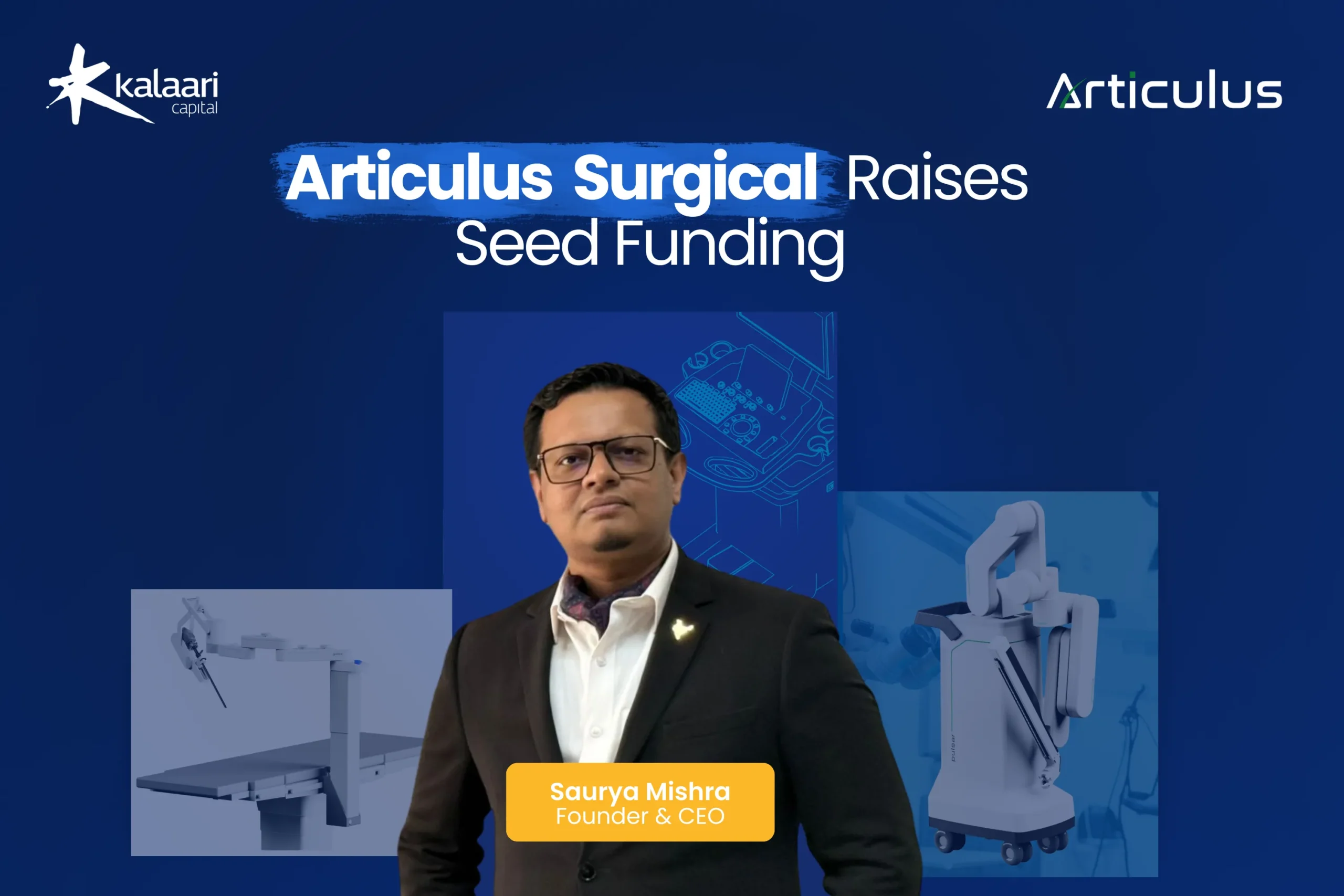
Saurya Mishra (Founder & CEO) brings deep medtech product development experience from his time leading hardware R&D at Morphle and working on CE/FDA-grade products at Philips. His background combines the regulatory rigor needed for medical devices with the startup agility required to move fast in a capital-intensive category. This experience, combined with the deep systems expertise he brings makes us excited about the vision to make accessible surgeries a reality
What stood out to us was the team’s commitment to first-principles thinking. Rather than accepting the constraints of existing robotic systems, they’ve questioned every design choice—from the foldable modular cart architecture to the universal surgical training platforms—through the lens of India’s hospital workflows, surgeon training pipelines, and cost sensitivities.
Saurya Mishra, Founder and CEO, says: “Surgical access should not be defined by location, infrastructure, or economic barriers. At Articulus, we went back to first principles to rethink how surgical innovation can penetrate every kind of operating room, from advanced urban centres to resource-constrained healthcare settings. We believe India must move from adopting surgical technologies developed elsewhere to building its own globally competitive platforms. For us, this is about technological sovereignty in critical healthcare infrastructure, ensuring that the future of surgical robotics is shaped, built, and advanced from within our own ecosystem.
Our approach has been shaped by relentless feedback from clinicians, whose insights inform every product decision and iteration, ensuring we build solutions grounded in real surgical need. Alongside this, we have deliberately developed simulation platforms to train tomorrow’s surgeons, because building widespread surgical robotics capability is fundamental to transforming outcomes at scale.
We are proud to partner with Kalaari Capital, whose deep understanding of the India ecosystem and long-standing experience backing category-defining companies makes them an exceptional partner for this next phase of growth. Together, we are committed to expanding access to thehighest standards of surgical care and to building a future where minimally invasive surgery is not a privilege for a few, but a standard of care accessible to patients everywhere”
Pranav Koshal, VP at Kalaari Capital, says: “India has a unique opportunity to leapfrog an entire generation of surgical technology. Today, 70% of surgeries in India are still open procedures—we haven’t even fully transitioned to laparoscopic surgery. Articulus is enabling a different trajectory: going directly from open surgery to affordable, accessible robotics. The immediate focus is India—building a platform that works for India’s operating rooms, training infrastructure, and hospital economics. But if we succeed here, the global opportunity becomes real. A platform designed for India’s constraints—compact ORs, cost sensitivity, rapid training cycles—could naturally extend to Southeast Asia, Latin America, Africa, and also hospitals in developed markets that face similar challenges. This is potentially an India-to-world innovation, and it starts with solving India first.”
Kalaari Capital is an early-stage, technology-focused venture capital firm based out of Bengaluru, India. Since 2006, Kalaari has empowered visionary entrepreneurs building unique solutions that reshape the way Indians live, work, consume and transact. The firm’s ethos is to partner early with founders and work with them to navigate the inevitable challenges of fostering ideas into successful businesses. At its core, Kalaari believes in building long-term relationships based on trust, transparency, authenticity, and respect.
If you are a founder building an early-stage company, write to us at pitch@kalaari.com