






Voice AI has advanced by leaps and bounds in recent years. The potential of voice AI has been evident ever since Siri, Alexa and the likes became the go-to interface for millions of people around the world.
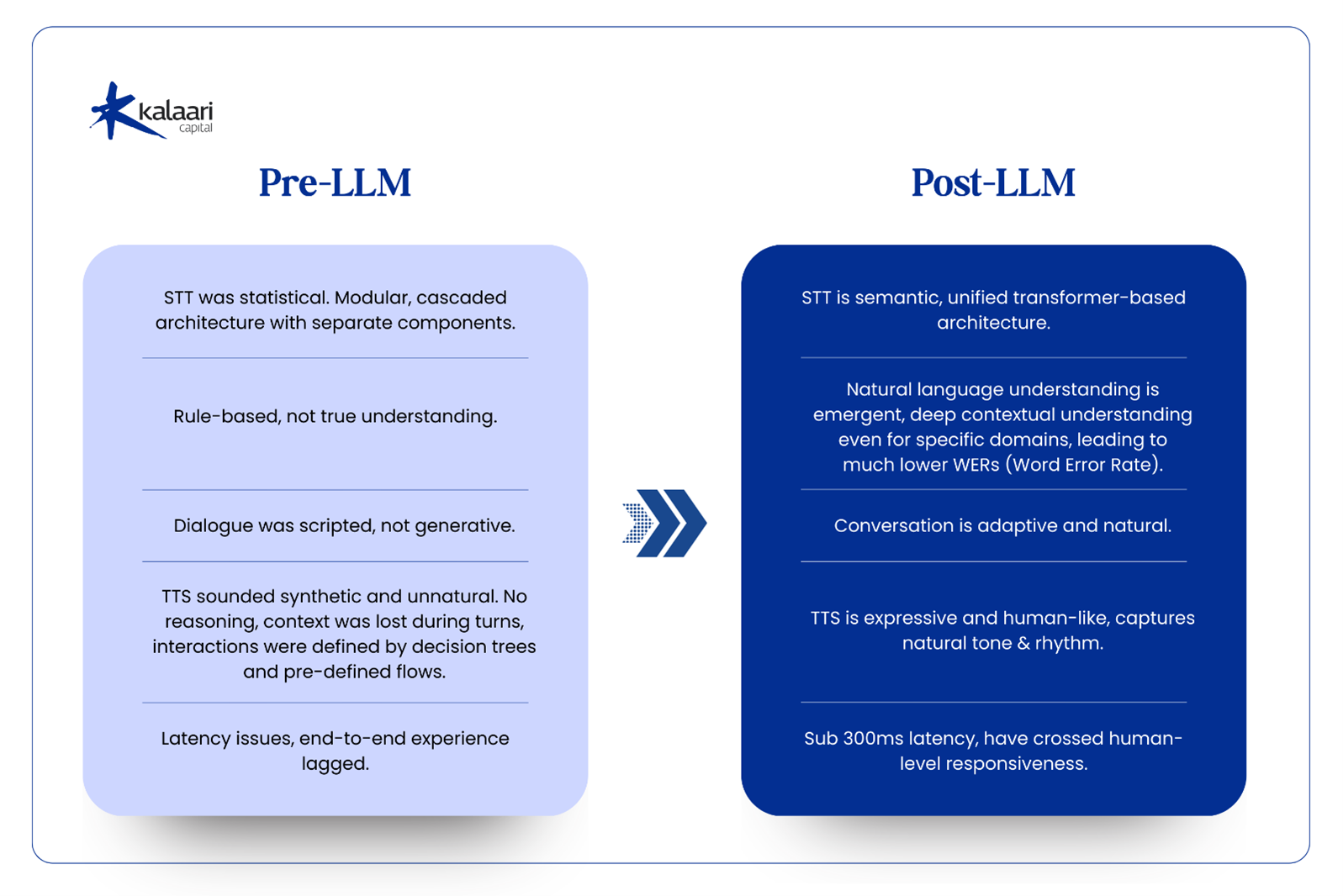
In the pre-LLM era, Voice AI applications were functional but listening accuracy wavered, responses lagged, and the voices sounded unmistakably synthetic. Voice Systems could follow commands, set reminders, or answer basic queries, but it was still very hard to effectively capturing context, nuances, interruptions, emotions, and anything that resembles an open-ended dialogue.
The arrival of large language models has been a game-changer. The current crop of voice models understands intent, maintains context, reasons through complexity, and respond with human-like pacing, tone, and rhythm. Latency has dropped below the 300ms benchmark making conversations more natural.
Models can now detect sentiment, adapt to accents, handle background noise, and generate expressive, emotionally aware speech. For the first time, voice interfaces have crossed into a zone of real intelligence and practicality, unlocking use cases across industries that were simply not possible before.
Use-cases like hands-free workflow automation for frontline workers in logistics, healthcare, or AI concierges for retail, restaurants, and hospitality, are only now starting to emerge.
But, it isn’t just the generative AI wave driving momentum for Voice AI. Even in mature areas like customer service, there is unmet opportunity.
- According to a Zendesk survey, two out of three customers who frequently interact with support wish they could engage more with AI via voice.
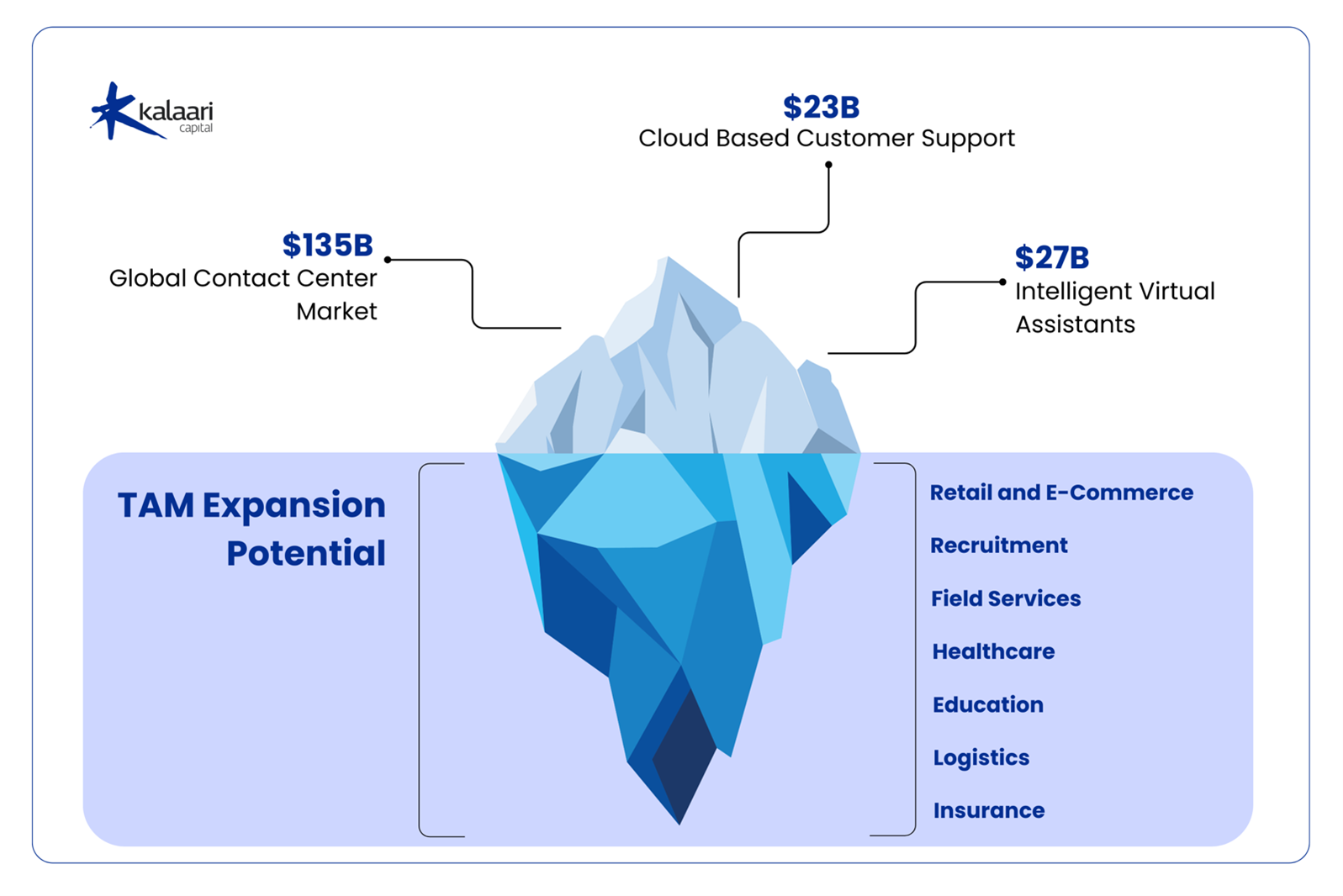
- The $135B Call Center and CX market is still just 40% of total market, comprising of large enterprises. A huge opportunity remains in the mid-market and MSME segment to be captured.
- Verticals like Field Operations, Facilities management, Retail and BFSI that have historically lagged in adoption are quickly demanding products.
With verticalization of SaaS emerging as a key trend, there many companies that are reimagining an AI-native user experience with voice.
However, despite the massive demand and opportunity. There is still a lot that is yet to be solved.
As per a Deepgram survey, in Enterprises with >$100M in revenue, 80% use voice agent systems & software, yet only 21% are satisfied. For companies experimenting with the latest solutions, less than 5 percent of new AI pilot projects are making it to production, as per MIT.
Making Voice AI natural and scalable is hard
Taking an agent from good to great requires deeper learning loops, integration work, and contextual adaptation.
- At enterprise scale of millions of calls, Latency increases, voice quality declines, costs escalate, quality reduces, and hallucinations increase.
- Deployments require integration with legacy systems of record and data scattered across silos.
- Domain understanding & context is required to incorporate industry-specific workflows and jargon- Insurance claims processing, healthcare scheduling, clinical notes dictation.
- Maintaining an agent’s voice quality under challenging scenarios- Mixed language, Vernacular, Background noise makes the output uneven.
- Regulatory compliance remains a major adoption barrier.
Building reliable Voice Agents requires Evals and Observability systems
Every Voice AI system lives or dies by how well it performs in the ‘real world’. A tedious amount of time and manual effort is spent on triaging edge cases and manually listening to call recordings to figure out where things are breaking. For companies where call volumes run in thousands a day, complexities result in massive productivity and business loss.
This is where Evals become critical. To identify which components are failing, by how much, and under what conditions. They replicate real-world patterns at scale, so teams can measure how robust their system truly is—not just how well it performs on a clean, lab-friendly dataset.
Evals capture business logic, and ensure that Voice AI aligns with workflow rules, regulatory requirements, and domain-specific KPIs. Whether it’s correctly routing customer support calls, capturing patient symptoms in healthcare, or qualifying leads in sales, evals verify that the system delivers the intended business outcomes.
Due to the unpredictability of user calls and the many edge cases they introduce, continuous observability becomes essential for Voice AI agents.
This is where SuperBryn comes in.
Superbryn – The Evaluation and Observability platform for Voice AI
SuperBryn aims to become the default layer for Voice AI applications – to help teams build smarter and more reliable agents.
What they do-
- Instead of manually listening to call recordings to pinpoint issues, the platform allows teams to upload recordings and SOPs; and automatically identifies failure points and surfaces them through a natural language interface.
- Allows developers to run technical evaluations for measuring latency, instruction compliance, and custom metrics for tailored workflows.
- Allows tweaking voice quality, tuning agent responses under different simulated environments, and running A/B tests, replay prompt changes at scale.
- Allows rigorous stress testing for agents and to continuously observe and monitor, especially critical in regulated sectors where even a single non-compliance instance can trigger scrutiny.
Over time, SuperBryn aims to evolve into becoming the self-learning system that continuously monitors and improves voice agents in production.
The Founding team making voice AI work
Nikkitha Shanker, Co-founder & CEO, is a second-time founder and a graduate from NIT Calicut. She spent the past decade building and scaling technology products. She co-founded Shoppre, an e-commerce platform and bootstrapped it to profitability, growing it to more than a million users across 140 countries. She believes voice is the next major interface for human–AI interaction and truly believes that SuperBryn will play a central role in this shift.
Neethu Mariam Joy, Co-founder & CTO spent her career studying the science that makes voice technology work. With a PhD from IIT Madras and postdoctoral research at King’s College London, she worked on enterprise NLP problems at ZS Associates and Uniphore. She is a leading voice in the Voice AI space and has worked extensively in both driving innovation and solving problems.
Together, they blend rigorous technical depth with on-ground execution, a mix we believe is essential for building in today’s fast-moving AI landscape.
Looking ahead
Currently, the team is engaging with multiple customers and early design partners across sectors.
The funding will help accelerate product development, expand engineering capability, and help the team arrive at the most critical sub-markets and verticals.
We are super excited to be leading Superbryn’s pre-seed round and to welcome Nikkitha and Neethu to the Kalaari and CXXO family.
Nikkitha, Co-founder & CEO of SuperBryn shares –
Kalaari has been a true thought partner from day one. They backed us even when we were still figuring things out, and in every conversation, the team engaged in a very hands-on, operator-led way. They challenged our assumptions, gave honest feedback, and importantly, pushed us to think bigger. Through CXXO, they also opened access to a strong community of women founders, offering peer learning, shared experiences, and perspectives that go far beyond capital.
Jayraj Patel, AVP at Kalaari Capital says –
Voice AI is at an inflection point, enterprises are moving from experimentation to scaled deployment, but reliability remains the biggest bottleneck. SuperBryn will fill a critical missing layer with independent evaluation, monitoring, and continuous improvement. Nikkitha and Neethu are extremely passionate about setting the reliability standard for voice AI applications and bring the technical depth needed to solve this for teams around the world. We are super excited to partner with them on this journey.
Kalaari Capital is an early-stage, technology-focused venture capital firm based out of Bengaluru, India. Since 2006, Kalaari has empowered visionary entrepreneurs building unique solutions that reshape the way Indians live, work, consume and transact. The firm’s ethos is to partner early with founders and work with them to navigate the inevitable challenges of fostering ideas into successful businesses. At its core, Kalaari believes in building long-term relationships based on trust, transparency, authenticity, and respect.
If you are a founder building an early-stage company, write to us at pitch@kalaari.com
CXXO is a Kalaari Capital initiative focused on expanding the funding pool for women-led startups in India. With a $10M carve-out from Kalaari’s fund, CXXO backs early-stage women founder-CEOs with fair access to capital, mentorship, and community support.
Launched in 2021, CXXO is committed to levelling the playing field and creating more female founder-CEOs who can build scalable ventures and shape India’s digital future.